TL;DR: The Medallion Architecture in Databricks structures data into Bronze, Silver, and Gold layers to progressively improve quality and trust. By treating schemas as a central source of truth, you can automatically generate ingestion, validation, and transformation logic, ensuring data quality is enforced consistently across the entire pipeline.
Modern data platforms have evolved far beyond simple storage systems. They now act as transformation engines that ingest, refine, and serve data from a wide variety of sources such as APIs, event streams, files, and SaaS systems.
As data volume and complexity grow, the challenge shifts from simply collecting data to ensuring it is correctly structured, validated, and governed throughout its lifecycle.
This is where the Databricks Medallion Architecture becomes particularly powerful.
Bronze, Silver, Gold: A Progressive Refinement Model
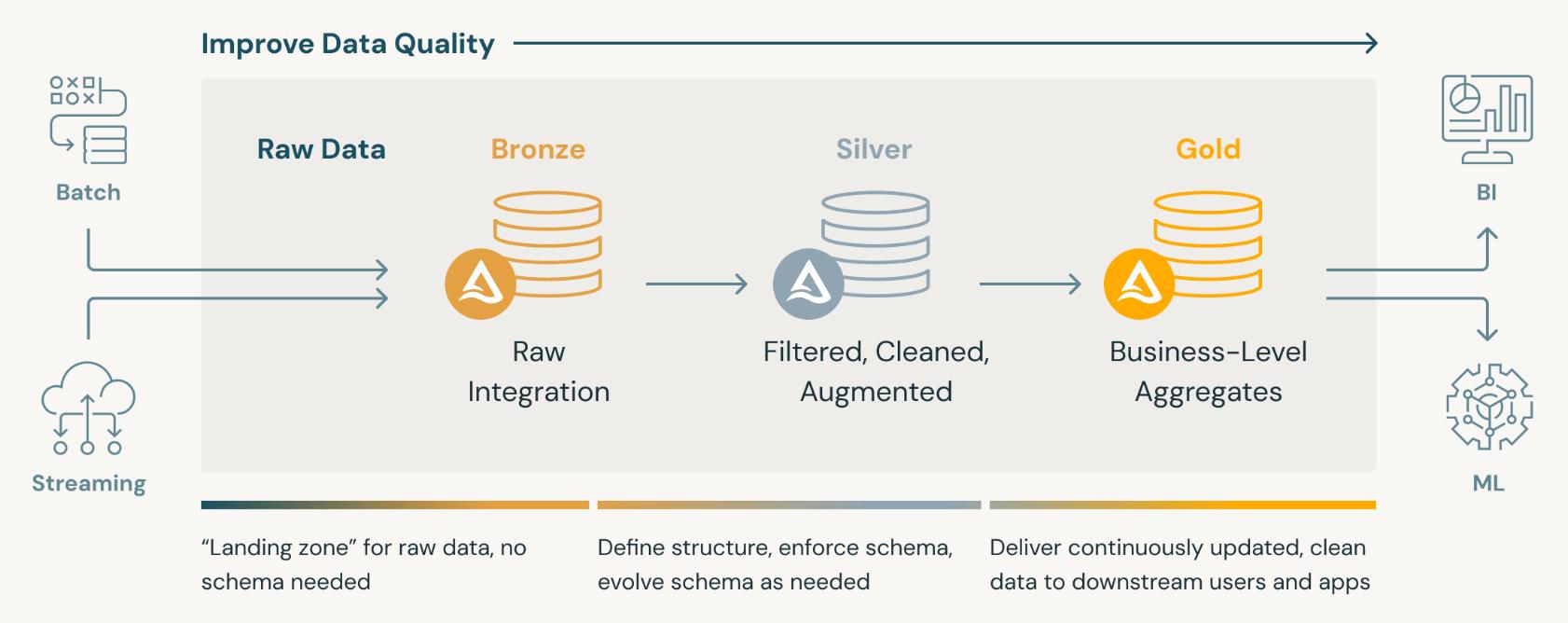
The Medallion Architecture organises data into three layers of increasing quality and usability:
Bronze → Raw ingested data with minimal transformation
Silver → Cleaned, validated, and conformed datasets
Gold → Business-ready, aggregated, and analytics-optimised data
This layered approach ensures that data quality is not assumed at ingestion, but progressively established through controlled transformations.
Bronze Layer: Preserving Raw State
The Bronze layer is the system’s immutable entry point. Data is ingested in its original form, whether it comes from files, APIs, or streaming sources.
The key principle here is preservation over transformation. Data is not corrected or reshaped at this stage, ensuring full traceability and replayability.
Raw schema preservation
Source metadata retention
Ingestion timestamps for lineage tracking
Auditability and replay capability
This layer acts as a safety net, ensuring that the original truth is never lost, even if downstream transformations evolve over time.
Silver Layer: Enforcing Structure and Rules
The Silver layer is where raw data is refined into a usable form. This is the point where business rules and data quality constraints are applied.
Typical transformations include:
Type enforcement and schema alignment
Deduplication and cleansing
Validation of business constraints
Joining and conforming related datasets
This is also where centralised schema definitions become critical. Instead of scattering transformation logic across multiple pipelines, a single schema definition can describe:
Field types and nullability
Relationships between entities
Validation constraints
Naming and transformation rules
In effect, the schema becomes an executable contract that ensures consistent behaviour across all ingestion and transformation pipelines.
Gold Layer: Curated Business Data
The Gold layer represents the final refinement stage, where data is structured for direct consumption by analytics tools and reporting systems.
At this level, data is typically:
Aggregated into meaningful business metrics
Denormalised for query performance
Aligned with business concepts rather than source systems
Examples include revenue summaries, customer analytics datasets, and operational KPI tables designed for dashboards and reporting tools.
By the time data reaches this layer, it has been fully validated and shaped into a trusted representation of business reality.
Schema-Driven Data Engineering
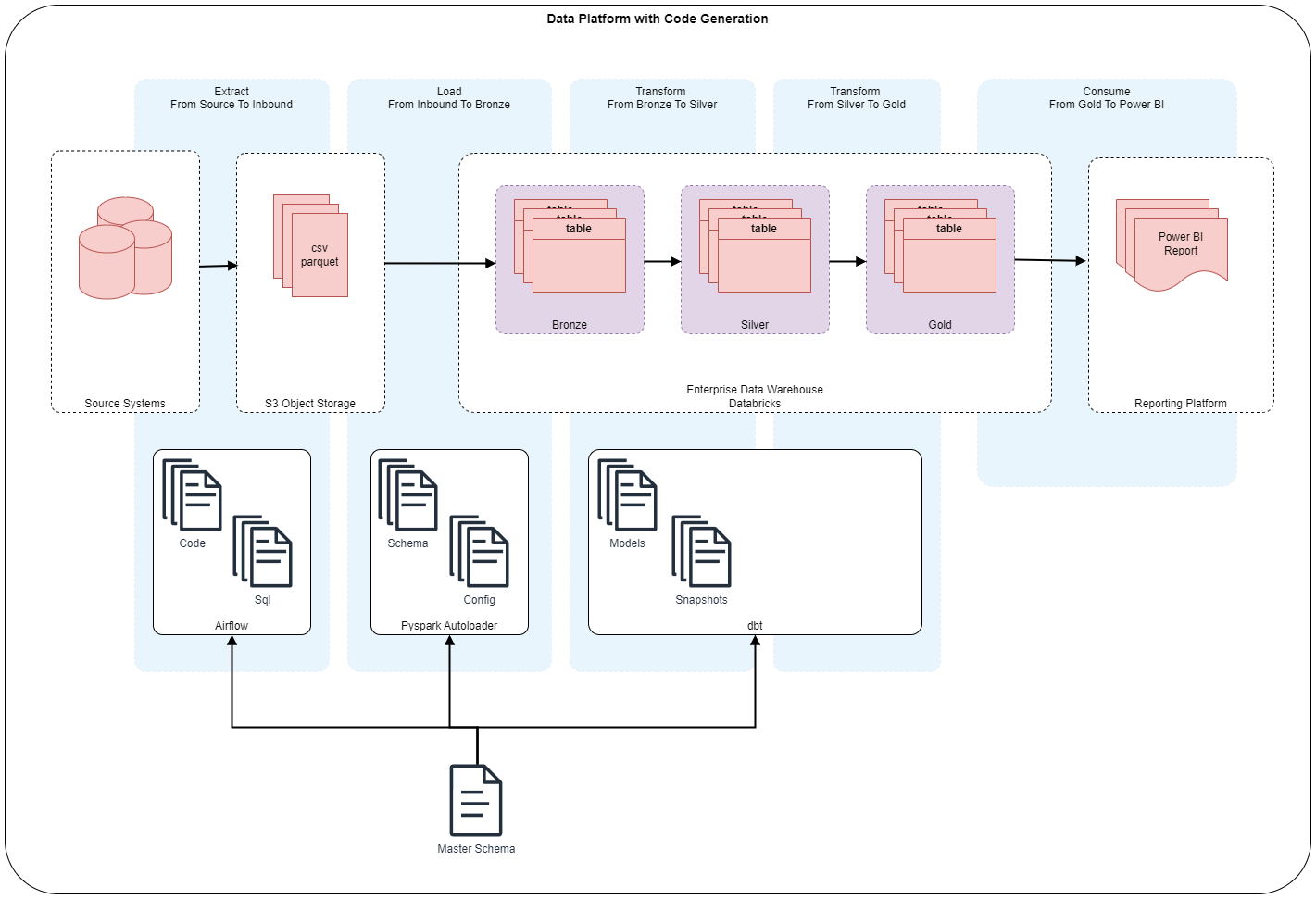
A key advancement in modern data platforms is treating schemas as the single source of truth for the entire pipeline.
Rather than manually building ingestion jobs, transformation logic, and validation rules, a schema definition can be used to generate them automatically.
This enables:
Consistent ingestion pipelines
Automated transformation logic generation
Standardised validation across datasets
Reduced duplication of engineering effort
The platform becomes declarative rather than procedural: you define what the data should look like, and the system generates how it gets there.
The Core Idea
The Medallion Architecture is fundamentally about controlled refinement of trust.
Data is not assumed to be correct at entry. Instead, trust is established incrementally as it moves through well-defined layers of transformation and validation.
If a business rule states that a report must never contain invalid or inconsistent records, the architecture ensures those conditions are eliminated before data reaches the Gold layer.
In this way, schema-driven design turns data quality rules into enforceable system behaviour rather than optional implementation detail.